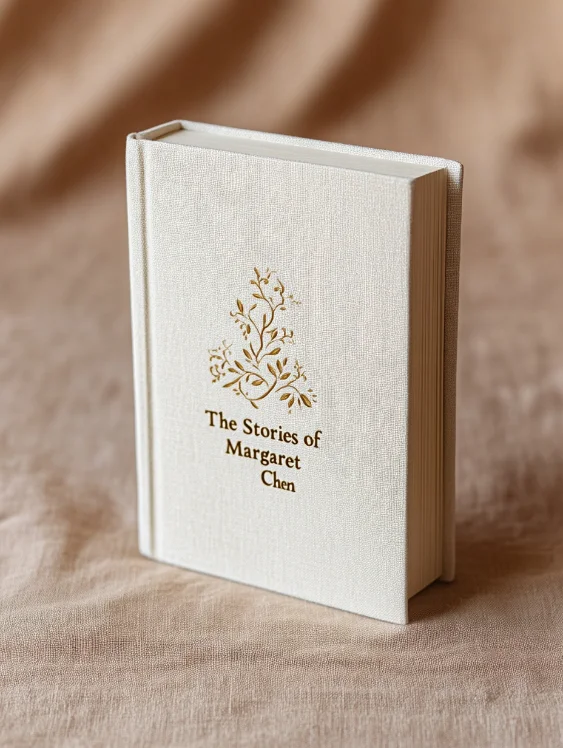
The physical hardcover

An open spread — see the type and paper
Every Bookie book is different — because every life is different. Margaret Chen raised three kids, burned garlic every single time, and slow-danced in the kitchen when she thought no one was watching. Her family made this book so her grandchildren would know who she was.
The first thing you need to understand about my mother's kitchen is that nothing in it matched. The cutting board was a slab of maple her father milled in 1962. The pot rack was a length of copper pipe my dad hung with picture wire the year they moved in, and it never hung straight, and she never let him fix it. The radio on top of the refrigerator had been tuned to KQED since before I was born. She didn't listen to it so much as let it keep her company.
She burned garlic every single time. Not because she didn't know better — she'd been cooking since she was nine, standing on a step stool in her grandmother's kitchen in Tainan, learning to fold dumplings with hands still too small to crimp the edges properly. She burned the garlic because she always got distracted at the exact wrong moment: wiping the counter, answering the phone, telling one of us to stop running in the house. The kitchen would fill with that sharp, almost-bitter smell, and she'd say the same thing every time — "Adds character" — and keep going.
The thing about her kitchen is that it was never just a kitchen. It was where she checked your homework while the rice steamed. Where she told you she was disappointed in you, in a voice far worse than yelling. Where she slow-danced with my father to whatever was on the radio while she thought no one was watching. I watched every time. From the hallway, through the gap in the door — the two of them swaying next to the stove, her head against his chest, a dish towel still over her shoulder.
After she got sick, she stopped cooking for a while. We all pretended not to notice. Then one Sunday she came downstairs at six in the morning, tied on her apron — the blue one with the grease stain that had survived twenty years of washing — and made dumplings for fourteen people. Nobody had been invited. She just started calling. "Come eat," she said. "I made too many." She always made too many. That was the point.
"My dad passed two years ago, and we made his book last Christmas. Now my son reads it before bed and asks me to tell him about Grandpa. The book remembers the things I'd already started to forget."
"I gave Mom her book at her 70th birthday. She read the first page out loud, and everyone went quiet. It lives on her nightstand now, not the shelf."
"I'd been 'writing my book' for two years and never finished. Three weeks with Bookie and it was done, in my own voice. Two new clients told me the book is why they called."
You don't need to be a writer. You just need to show up and talk. Bookie handles the rest.
Start chapter one — free